
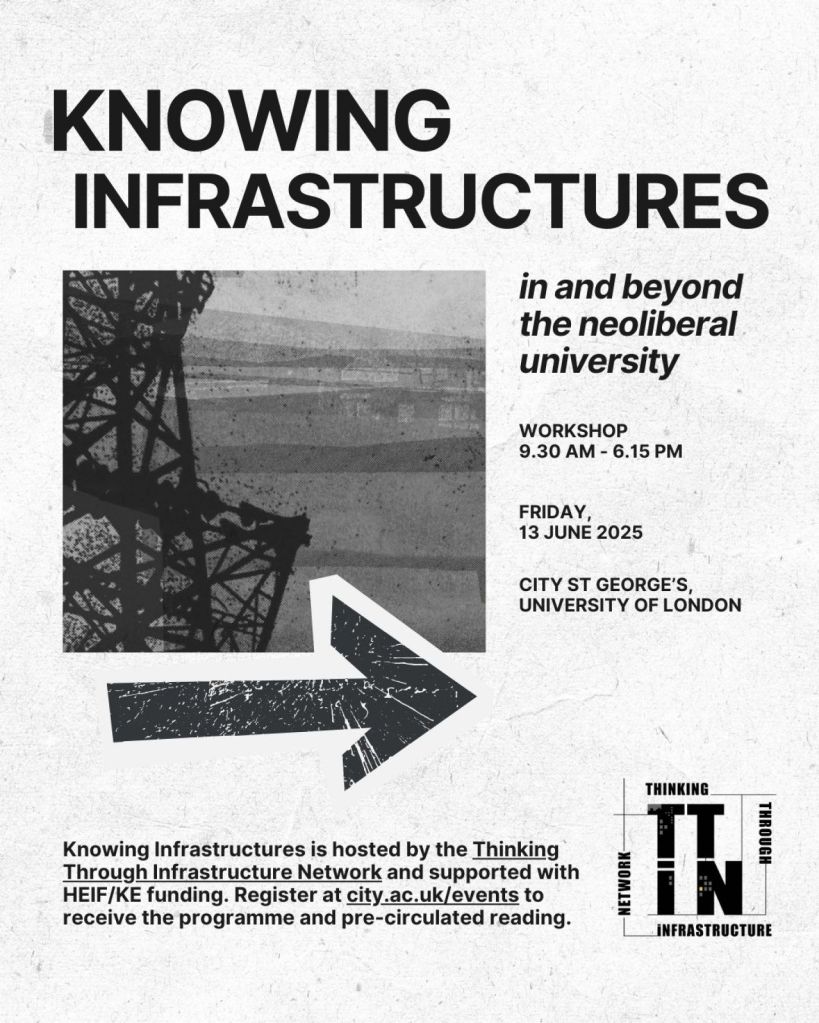
On Friday 13 June 2025 I am participating in the Knowing Infrastructures workshop. My discussion paper is titled “Teaching Against the Grain: Reclaiming Uncertainty in Assessment and Learning“.
In Pedagogy of the Oppressed (1968), Paulo Freire argues that the path to liberation lies in a dialectical unity of theory and practice—what he calls praxis—driven by “epistemological curiosity.” Yet in the twenty-first-century neoliberal university, this curiosity is stifled by both institutional structures and student expectations shaped by a culture of instrumentalism.
Arguably, most of today’s students, conditioned by years of institutional programming, often demand clear, measurable, pragmatic tasks; they view uncertainty not as a space for inquiry but as a source of anxiety. Education has increasingly become a transactional process oriented towards certifications, metrics, and compliance—often resembling a “colour-by-numbers” system that leaves little room for exploration, discovery, or critical engagement.
I will argue that reorganising knowledge infrastructures in teaching and assessment requires reclaiming Freire’s vision of education as a transformative, dialogical process. We must challenge not only top-down neoliberal pressures (governance, assessments, policy) but also the internalised habits of students and educators alike, which prioritise rote mastery over critical questioning.
To do so, we must foster environments that embrace uncertainty, ambiguity, and problem-posing approaches, where knowledge is co-produced through dialogue rather than transmitted through step-by-step instructions. In a moment when generative AI threatens to further automate intellectual labour, it becomes even more urgent to resist the reduction of teaching and assessment to speed, efficiency, and product. I’ll advocate designing learning environments that centre collective critical reflection, and an openness to the unknown—the very capacities that make true learning possible.
If we are serious in our concern that Generative AI might have negative consequences for education, akin to generalised plagiarism, we should really look into the pedagogical cultures educational institutions impose on both staff and students. What are the ways in which both teaching staff and students can resist the current “delivery” and “assessment” infrastructures? In an always-already capitalist context where students are consumers and staff service providers, are there ways to not betray a different understanding of education, which is not necessarily about “preparing students for employment” but preparing them as critical learners able to adapt to new frameworks?
Find out more about the full programme tomorrow at https://www.citystgeorges.ac.uk/news-and-events/events/2025/june/knowing-infrastructures-in-and-beyond-the-neoliberal-university/.

 Everything is Connected
You must be logged in to post a comment.