
The UK Covid-19 Inquiry was set up “to examine the UK’s response to and impact of the Covid-19 pandemic, and learn lessons for the future”. At the time of typing this, you can catch up with the developments from the coverage here, or directly from the video recordings here, if you find the time.
The evidence that has been presented at the Inquiry is hugely significant, but it is, sadly, nothing truly new. Yes, it is very good all of this is being made transparent and documented; the big question is whether anything will be done about it. What the Inquiry has also revealed is a tragic historical amnesia, and/or a collective inability or unwillingness to have interrogated the 2020 developments closely and efficiently as they were happening. Having done so could have saved many lives.
For me, the Inquiry has brought back memories of the days in which I was making my personal efforts to document the early days of the UK pandemic via my Lockdown Chronicles comic strip series, originally serialised as posts on this blog (the first 40 strips are available as a nifty limited edition book which you can buy via Good Comics).
After lockdown was lifted in the UK I continued the series, somewhat erratically, exploring other formal constraints that set them apart from the initial run. I started focusing on the data charts from the UK Coronavirus Dashboard, and attempted ways to recontextualise and revisualise the data, often in darkly humorous ways. The way the pandemic was being (un)managed seemed to me farcical, worthy of bitter parody.
It’s been really interesting and frustrating for me to see how much of the evidence presented at the Inquiry correlates with what I documented in the Lockdown Chronicles. This week, one instance in particular brought me back to two specific posts I made in January 2021, when it was clear all the indicators were up once again.
On Monday 20 November 2023 the former chief scientific adviser, Sir Patrick Vallance, was clear that the PM would almost certainly have known concerns over ‘eat out to help out’ scheme, directly contradicting the prime minister’s evidence to the Covid inquiry. As reported by the Guardian, Vallance said:
“Up until that point, the message had been very clear, which is interaction between different households and people that you weren’t living with in an enclosed environment with many others was a high-risk activity. That policy completely reversed it”.
Also Wallance:
“It is very difficult to see how it would not have had an effect on transmission and that would have been the advice that was given.”
In characterstically cautious way, Vallance is saying that it was blindingly obvious that ‘eat to help out’ had an effect on increasing transmission.
Now please consider my January 12 and January 13, 2021 posts below:

The Lockdown Chronicles Year 2: Paying Dividends (Eoho!), https://ernestopriego.com/2021/01/12/the-lockdown-chronicles-year-2-paying-dividends-eoho/
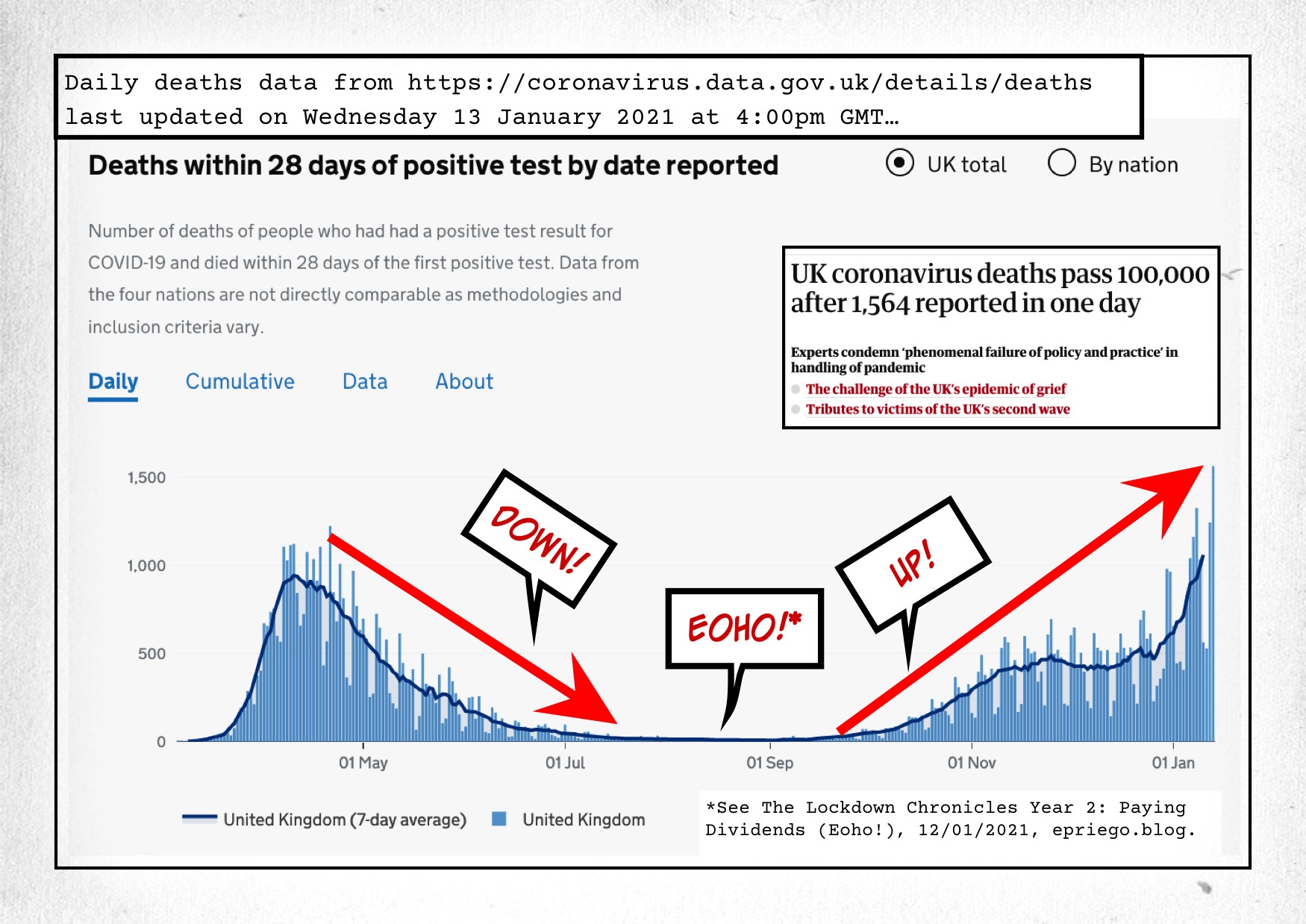
The Lockdown Chronicles Year 2: Pass 100,000 https://ernestopriego.com/2021/01/13/the-lockdown-chronicles-year-2-pass-100000/
According to the Guardian, “Sunak had written to the inquiry saying he “[did] not recall any concerns about the scheme” being raised in ministerial meetings“, as if that somewhat excused the policy, when it was obvious to anyone who wanted to see it that the [EOHO] scheme not only “reversed” the social distancing policy but very clearly contradicted all possible knowledge about how viruses spread.
We do not need this Inquiry to prove the EOHO scheme was driven by populism and the economy at the expense of the lives and health of the population. We knew it at the time, we confirmed it 6 months later; during this Inquiry it is being proven beyond all reasonable doubt. Apparently the people in charge did not hear any concerns: it is clear they did not want to hear them.

 Everything is Connected
You must be logged in to post a comment.